
Skipping the permit process, choosing the wrong decking material, or hiring a contractor without verified waterway experience, these decisions don’t just cause headaches. They cost real money, sometimes tens of thousands of dollars, and they delay projects by months. Dock and seawall work in Southwest Florida carries a specific set of failure points that repeat themselves constantly, and most of them are entirely avoidable.
Treating Permits as an Afterthought
Permitting is where most residential dock projects go sideways first. Collier County, the Army Corps of Engineers, and the Florida Department of Environmental Protection each have their own review requirements, and they don’t move on the same timeline. A project that touches navigable water or a protected shoreline can require multiple concurrent applications. Owners who start construction before approvals are in hand risk stop-work orders, fines, and mandatory removal of completed work.
J&M Marine Construction is direct about this with clients: starting without a permit is never a shortcut. It is a longer, more expensive path. The cost of proper permit preparation and submission is a fraction of what removal and reconstruction costs if work is done out of sequence.
For HOA-governed waterfront properties in Naples, FL, there is an additional layer. Community boards often have their own approval process that runs parallel to county permitting. Missing that step can void your approval even after the county signs off. Anyone managing a shared waterfront project should review the specifics around project planning for HOAs and condo boards before breaking ground.
Choosing Materials Based on Upfront Price Alone
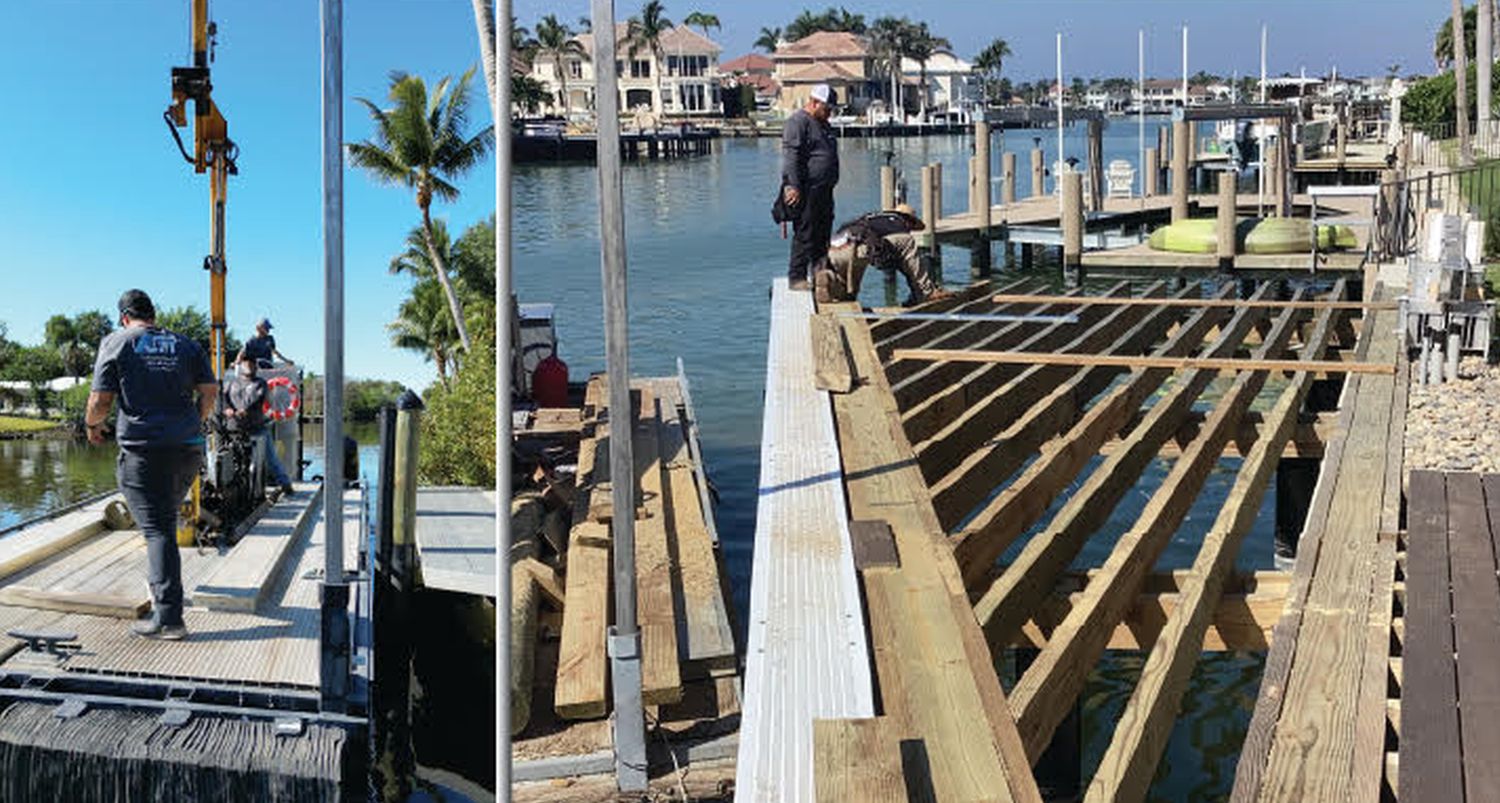
Pressure-treated pine is cheap at purchase. In brackish or saltwater conditions, it can begin showing serious deterioration in five to eight years. Composite decking, aluminum framing, and stainless hardware cost more upfront, but the maintenance gap over a 20-year period is significant. Owners who build a standard wood dock to save $8,000 often spend that amount again within a decade on board replacement, hardware corrosion, and structural repairs.
The specific failure modes matter here. Galvanized hardware corrodes faster than most owners expect in tidal environments. Untreated or under-treated wood at the waterline wicks moisture and splits. Aluminum framing, by contrast, handles the salt exposure well and requires almost no structural maintenance. Composite decking upgrades are one of the most common retrofits J&M marine building services performs on docks that were originally built to a budget.
The calculus is simple. Spend more on materials that suit the environment, or spend more later on repairs that could have been avoided.
Ignoring What’s Already Failing Below the Surface
A dock that looks fine from the top can be structurally compromised at the piling level. Marine borers, specifically Teredo worms and Limnoria, attack untreated or inadequately treated wood pilings from the waterline down. The damage is internal. You cannot see it from above. By the time a piling shows visible deterioration, it may have lost 40 to 60 percent of its load-bearing capacity.
Seawalls are equally deceptive. Hairline cracks in concrete panels allow water intrusion. Over time, that water erodes the fill behind the wall, creating voids that eventually cause panel failure or land subsidence. In areas like the Quarry community in Naples, FL, where residential properties back directly onto managed lakes and waterways, seawall integrity is not a cosmetic issue. It is a structural one with real property value implications.
Scheduling a dock and seawall inspection before purchasing waterfront property, or before starting any renovation, is one of the most cost-effective steps a property owner can take. What gets found early is almost always cheaper to fix than what gets found after a failure event.
Underestimating the Scope of Lift and Accessory Work
Boat lift installation is not a standalone task. The dock structure itself must be engineered to handle the load. A 10,000-pound lift places very different demands on a dock frame than a 4,500-pound lift, and the difference matters at the piling connections, the cross-bracing, and the decking around the lift bay. Owners who buy a lift independently and then ask a contractor to “just install it” frequently discover that the existing structure needs reinforcement first.
Accessories compound this. Adding a canopy, a second lift, or extended platforms after the fact often means re-engineering sections of the dock that were not built with those loads in mind. The smarter approach is to plan for the full scope from the start, including any anticipated additions. Platforms, canopies, and upgrades are far less expensive when they are part of the original design than when they are retrofitted onto a structure that wasn’t built to accommodate them.
Lift motors and cables also fail on a predictable schedule. Ignoring early signs of wear, slipping, or unusual noise leads to full motor failure, which means a boat stuck in the water at the worst possible time. Lift repairs and motor and cable replacement handled proactively cost a fraction of emergency service calls.
J&M waterfront construction works throughout Naples, FL and the surrounding Southwest Florida waterfront communities. The team can be reached at 2496 Kirkwood Ave, Naples, FL 34112, or by phone at (239) 353-7326, and serves as a practical resource for owners who want straight answers before committing to a project.
Frequently Asked Questions
What happens if I start my dock project without the necessary permits?
Starting construction without permits can lead to stop-work orders, fines, and the need to remove completed work. The cost of proper permit preparation is much lower than the expenses associated with removing and reconstructing work done out of sequence.
How do I choose the right materials for my dock?
Choosing materials based solely on upfront cost can be a mistake. For example, pressure-treated pine may be cheap initially, but it can deteriorate in saltwater conditions within five to eight years, leading to higher long-term costs for repairs and replacements.
What should I look for when inspecting my dock before renovation?
A dock that appears fine on the surface may have serious structural issues below, such as damage from marine borers. Scheduling a thorough inspection can help identify problems early, which are usually cheaper to fix than those found after a failure occurs.
Why is it important to consider lift and accessory work in my dock design?
Boat lifts and accessories require that the dock structure is engineered to handle additional loads. If these aspects are not planned for initially, it can lead to costly re-engineering and reinforcement of the dock after construction.
Get Directions to J&M marine engineering projects
🎧 Listen to this as a podcast
Also on Apple Podcasts, Spotify, and Amazon Music.